Deadly tornadoes raked across Alabama on April 27, 2011, killing as many as 210 people as of April 29. The hardest-hit community was Tuscaloosa. In an image acquired by the Moderate Resolution Imaging Spectroradiometer (MODIS) on NASA’s Aqua satellite on April 28, three tornado tracks are visible through and around the city.
The tracks are pale brown trails where green trees and plants have been uprooted, leaving disturbed ground. Though faint, the center track runs from southwest of Tuscaloosa, through the gray city, and extends northeast towards Birmingham. Two other tracks run parallel to the center track. The northernmost track is in an area where the National Weather Service reported a tornado, but no tornado was reported in the vicinity of the more visible southern track. In the southern region, strong winds were reported.
NASA's Juno spacecraft has arrived in Florida to begin final preparations for a launch this summer. The spacecraft was shipped from Lockheed Martin Space Systems, Denver, to the Astrotech payload processing facility in Titusville, Fla., today. The solar-powered Juno spacecraft will orbit Jupiter's poles 33 times to find out more about the gas giant's origins, structure, atmosphere and magnetosphere. "The Juno spacecraft and the team have come a long way since this project was first conceived in 2003," said Scott Bolton, Juno's principal investigator, based at Southwest Research Institute in San Antonio. "We're only a few months away from a mission of discovery that could very well rewrite the books on not only how Jupiter was born, but how our solar system came into being."
To celebrate the 21st anniversary of the Hubble Space Telescope's deployment into space, astronomers at the Space Telescope Science Institute in Baltimore, Md., pointed Hubble's eye at an especially photogenic pair of interacting galaxies called Arp 273.
"For 21 years, Hubble has profoundly changed our view of the universe, allowing us to see deep into the past while opening our eyes to the majesty and wonders around us," NASA Administrator Charles Bolden said."I was privileged to pilot space shuttle Discovery as it deployed Hubble. After all this time, new Hubble images still inspire awe and are a testament to the extraordinary work of the many people behind the world's most famous observatory."
NASA's Mars Reconnaissance Orbiter has discovered the total amount of atmosphere on Mars changes dramatically as the tilt of the planet's axis varies. This process can affect the stability of liquid water, if it exists on the Martian surface, and increase the frequency and severity of Martian dust storms.
Researchers using the orbiter's ground-penetrating radar identified a large, buried deposit of frozen carbon dioxide, or dry ice, at the Red Planet's South Pole. The scientists suspect that much of this carbon dioxide enters the planet's atmosphere and swells the atmosphere's mass when Mars' tilt increases. The findings are published in this week's issue of the journal Science.
Mary Cleave left the NASA astronaut corps in the early 1990s to make a rare jump from human spaceflight to Earth science. She was going to work on an upcoming mission to measure gradations in ocean color something she had actually seen from low-Earth orbit with her own eyes. From space, differing densities of phytoplankton and algae and floating bits of plant life reveal themselves as so many blues and greens. For Cleave, a former environmental engineer, the attraction was simple.
"We were going to measure green slime on a global scale," said Cleave, now retired from her varied NASA career.That is exactly what SeaWiFS Sea viewing Wide Field of view Sensor did for over 13 years, until it recently stopped communicating with ground-based data stations and after several months of intensive efforts at recovery, was declared unrecoverable in February.
On March 29, 1807, German astronomer Heinrich Wilhelm Olbers spotted Vesta as a pinprick of light in the sky. Two hundred and four years later, as NASA's Dawn spacecraft prepares to begin orbiting this intriguing world, scientists now know how special this world is, even if there has been some debate on how to classify it.
Vesta is most commonly called an asteroid because it lies in the orbiting rubble patch known as the main asteroid belt between Mars and Jupiter. But the vast majority of objects in the main belt are lightweights, 100-kilometers-wide (about 60-miles wide) or smaller, compared with Vesta, which is about 530 kilometers (330 miles) across on average. In fact, numerous bits of Vesta ejected by collisions with other objects have been identified in the main belt.
The discovery of a pattern of X-ray “stripes” in the remains of an exploded star may provide the first direct evidence that a cosmic event can accelerate particles to energies a hundred times higher than achieved by the most powerful particle accelerator on Earth.
This result comes from a very long observation of the Tycho supernova remnant with NASA's Chandra X-ray Observatory. It could explain how some of the extremely energetic particles bombarding the Earth, called cosmic rays, are produced. “We've seen lots of intriguing structures in supernova remnants, but we’ve never seen stripes before,” said Kristoffer Eriksen of Rutgers University, who led the study. “This made us think very hard about what's happening in the blast wave of this powerful explosion.
Recent data from NASA's Cassini spacecraft show that the variation in radio waves controlled by the planet's rotation is different in the northern and southern hemispheres. Moreover, the northern and southern rotational variations also appear to change with the Saturnian seasons, and the hemispheres have actually swapped rates. These two radio waves, converted to the human audio range.
"These data just go to show how weird Saturn is," said Don Gurnett, Cassini's radio and plasma wave science instrument team lead and professor of physics at the University of Iowa, Iowa City. "We thought we understood these radio wave patterns at gas giants, since Jupiter was so straightforward. Without Cassini's long stay, scientists wouldn't have understood that the radio emissions from Saturn are so different."
Satellites have been busy this week covering severe weather across the U.S. Today, the GOES-13 satellite and NASA's Aqua satellite captured an image of the huge stretch of clouds associated with a huge and soggy cold front as it continues its slow march eastward. Earlier this week, NASA's Tropical Rainfall Measuring Mission satellite captured images of severe weather that generated tornadoes over Louisiana.
Today the eastern third of the U.S. is being buffered by a large storm that stretches from southeastern Minnesota east to Wisconsin and Michigan, then south through the Ohio Valley and all the way down to eastern Louisiana. That massive storm system was captured in an image by the Geostationary Operational Environmental Satellite called GOES-13.
NASA's Wide-field Infrared Survey Explorer, or WISE, captured this image of a star-forming cloud of dust and gas, called Sh2-284, located in the constellation of Monoceros. Lining up along the edges of a cosmic hole are several "elephant trunks" or monstrous pillars of dense gas and dust.
The most famous examples of elephant trunks are the "Pillars of Creation" found in an iconic image of the Eagle nebula from NASA's Hubble Space Telescope. In this WISE image, the trunks are seen as small columns of gas stretching toward the center of the void in Sh2-284, The most notable one can be seen on the right side at about the 3 o'clock position. It appears as a closed hand with a finger pointing toward the center of the void. That elephant trunk is about 7 light-years long.
{..Click to Continue..}
More than one hundred days ago, on Nov. 19, 2010, NASA sent a small satellite about the size of a loaf of bread on an important mission to answer astrobiology’s fundamental questions about the origin, evolution and distribution of life in the universe.
Since then, the nanosatellite, known as Organism/Organic Exposure to Orbital Stresses (O/OREOS) continues on its quest, which has taken it just about everywhere between the Arctic and Antarctic Circles more than 400 miles above Earth's surface.
{..Cilk to Continue..}
NASA's Chandra X-ray Observatory has discovered the first direct evidence for a superfluid, a bizarre, friction-free state of matter, at the core of a neutron star. Superfluids created in laboratories on Earth exhibit remarkable properties, such as the ability to climb upward and escape airtight containers. The finding has important implications for understanding nuclear interactions in matter at the highest known densities.
Neutron stars contain the densest known matter that is directly observable. One teaspoon of neutron star material weighs six billion tons. The pressure in the star's core is so high that most of the charged particles, electrons and protons, merge resulting in a star composed mostly of uncharged particles called neutrons.
The new Permanent Multipurpose Module (PMM) Leonardo should know its way around the International Space Station by now. This flight marks its eighth and final visit to the orbiting laboratory, its new home.
Leonardo was one of three Multipurpose Logistics Modules built by the Italian Space Agency under contract. It was delivered to Kennedy Space Center in 1998.Its first spaceflight was on Discovery’s STS-102 mission launched March 8, 2001. Leonardo brought six systems racks to the station: two robotic workstation racks for the station's robotic arm and its four cameras, two DC-to-DC converter units which convert electrical power from the station's solar arrays to a form usable by station systems and experiments, the U.S. lab Avionic 3 and a Crew Health Care System rack.
{..Cilk to Continue..}
What would our solar system look like if visitors from other worlds took a series of pictures NASA's MESSENGER spacecraft did just that by piecing together the first portrait of our solar system from the inside looking out. Comprised of 34 images, the mosaic provides a complement to the solar system portrait from the outside looking in taken by Voyager 1 in 1990.
"Obtaining this portrait was a terrific feat by the MESSENGER team," says MESSENGER principal investigator Sean Solomon, of the Carnegie Institution of Washington. "This snapshot of our neighborhood also reminds us that Earth is a member of a planetary family that was formed by common processes four and a half billion years ago. Our spacecraft is soon to orbit the innermost member of the family, one that holds many new answers to how Earth-like planets are assembled and evolve."
{..Cilk to Continue..}
NASA’s Dryden Flight Research Center is flight testing two new supersonic shockwave probes to determine their viability as research tools.
The probes were designed by Eagle Aeronautics of Hampton, Va., under a NASA Research Announcement, and manufactured by Triumph Aerospace Systems of Newport News, Va. The probes were first tested in a wind tunnel at NASA's Langley Research Center, also in Hampton. The new probes are being flown on NASA Dryden's F-15B research test bed aircraft. Supersonic flight over land is severely restricted in the United States and elsewhere because the sonic booms created by the shock waves propagating from supersonic aircraft are an annoyance to many and can damage private property.
In November 2010, the scientific journal Icarus published a paper by astrophysicists John Matese and Daniel Whitmire, who proposed the existence of a binary companion to our sun, larger than Jupiter, in the long-hypothesized "Oort cloud" a faraway repository of small icy bodies at the edge of our solar system. The researchers use the name "Tyche" for the hypothetical planet.
Their paper argues that evidence for the planet would have been recorded by the Wide-field Infrared Survey Explorer (WISE).WISE is a NASA mission, launched in December 2009, which scanned the entire celestial sky at four infrared wavelengths about 1.5 times. It captured more than 2.7 million images of objects in space, ranging from faraway galaxies to asteroids and comets relatively close to Earth. Recently, WISE completed an extended mission, allowing it to finish a complete scan of the asteroid belt, and two complete scans of the more distant universe, in two infrared bands.
{..Cilk to Continue..}
NASA is looking for a non-profit group to manage International Space Station research that's being performed in orbit under its designation as an official U.S. National Laboratory. Completed proposals are due April 1, 2011.
NASA plans to sign a cooperative agreement this year with an independent, nonprofit research management organization to stimulate, develop and manage use of the station by a wide pool of U.S. research organizations for all National Laboratory experiments. NASA will continue to manage its own research aimed at space exploration advances. As space station assembly is completed this year, NASA and its international partners are transitioning to full use of the unique scientific outpost for research. In an effort to ensure broad access to the orbiting laboratory, Congress designated the station a national laboratory in 2005.
Mission controllers at NASA's Jet Propulsion Laboratory, Pasadena, Calif., watched as data down linked from the Stardust spacecraft indicated it completed its closest approach with comet Tempel 1. An hour after closest approach, the spacecraft turned to point its large, high-gain antenna at Earth.
It is expected that images of the comet's nucleus collected during the flyby will be received on Earth starting at about midnight California time (3 a.m. EST on Tuesday, Feb. 15).Preliminary data already transmitted from the spacecraft indicate the time of closest approach was about 8:39 p.m. PST (11:39 p.m. EST), at a distance of 181 kilometers (112 miles) from Tempel 1.
{..Cilk to Continue..}
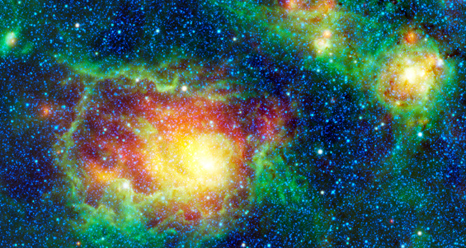
Stars at all stages of development, from dusty little tots to young adults, are on display in a new image from NASA's Spitzer Space Telescope. This cosmic community is called the North American nebula. In visible light, the region resembles the North American continent, with the most striking resemblance being the Gulf of Mexico. But in Spitzer's infrared view, the continent disappears. Instead, a swirling landscape of dust and young stars comes into view.
"One of the things that makes me so excited about this image is how different it is from the visible image, and how much more we can see in the infrared than in the visible," said Luisa Rebull of NASA's Spitzer Science Center at the California Institute of Technology, Pasadena, Calif. Rebull is lead author of a paper about the observations, accepted for publication in the Astrophysical Journal Supplement Series. "The Spitzer image reveals a wealth of detail about the dust and the young stars here."
{..Cilk to Continue..}
For the second time in less than a month, two Russian cosmonauts will venture outside the International Space Station on Feb. 16 to install a pair of earthquake and lightning sensing experiments, and to retrieve a pair of spacecraft material evaluation panels.
Expedition 26 Flight Engineers Dmitry Kondratyev and Oleg Skripochka are scheduled to float outside the Pirs airlock at 8:15 a.m. EST Wednesday to begin the five-and-a-half-hour excursion. Both spacewalkers will wear Russian Orlan-MK spacesuits. On their previous spacewalk, completed Jan. 21, they completed installation of a new high-speed data transmission system, removed an old plasma pulse experiment, installed a camera for the new Rassvet docking module and retrieved a materials exposure package. That spacewalk lasted 5 hours, 23 minutes.