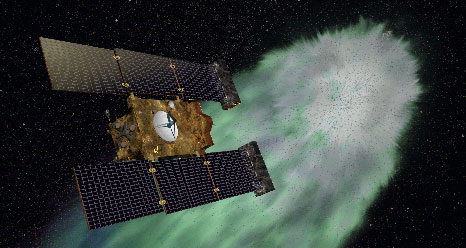
NASA's Stardust spacecraft sent its last transmission to Earth at 4:33 p.m. PDT (7:33 p.m. EDT) Thursday, March 24, shortly after depleting fuel and ceasing operations. During a 12-year period, the venerable spacecraft collected and returned comet material to Earth and was reused after the end of its prime mission in 2006 to observe and study another comet during February 2011.
The Stardust team performed the burn to depletion because the comet hunter was literally running on fumes. The depletion maneuver command was sent from the Stardust-Next mission control area at Lockheed Martin Space Systems in Denver. The operation was designed to fire Stardust's rockets until no fuel remained in the tank or fuel lines. The spacecraft sent acknowledgment of its last command from approximately 312 million kilometers (194 million miles) away in space.
Mission controllers at NASA's Jet Propulsion Laboratory, Pasadena, Calif., watched as data down linked from the Stardust spacecraft indicated it completed its closest approach with comet Tempel 1. An hour after closest approach, the spacecraft turned to point its large, high-gain antenna at Earth.
It is expected that images of the comet's nucleus collected during the flyby will be received on Earth starting at about midnight California time (3 a.m. EST on Tuesday, Feb. 15).Preliminary data already transmitted from the spacecraft indicate the time of closest approach was about 8:39 p.m. PST (11:39 p.m. EST), at a distance of 181 kilometers (112 miles) from Tempel 1.
{..Cilk to Continue..}
On February 11, 2010, at 10:23 in the morning, NASA's Solar Dynamics Observatory (SDO) launched into space on an Atlas rocket from Cape Canaveral. A year later, SDO has sent back millions of stunning images of the sun and a host of new data to help us understand the complex star at the heart of our solar system.
"One of the highlights of the last year is just that everything worked so smoothly," says astrophysicist Dean Pesnell, the project scientist for SDO at NASA's Goddard Space Flight Centerin Greenbelt, Md. "We turned it on in March and it immediately started sending us data at 150 megabits per second. It worked from the very get go."
NASA's Stardust spacecraft marked its 12th anniversary in space on Monday, Feb. 7, with a rocket burn to further refine its path toward a Feb. 14 date with a comet.
The half-minute trajectory correction maneuver, which adjusts the spacecraft's flight path, began at about 1 p.m. PST (4 p.m. EST) on Monday, Feb. 7. The 30-second-long firing of the spacecraft's rockets consumed about 69 grams (2.4 ounces) of fuel and changed the spacecraft's speed by 0.56 meters per second (1.3 mph).