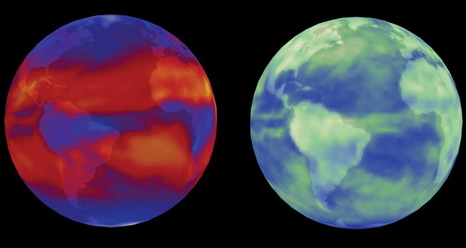
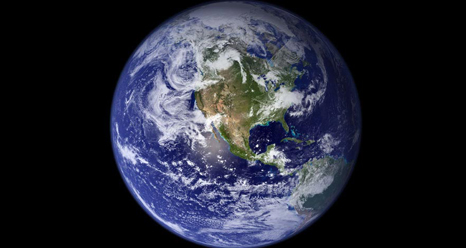
To celebrate Earth Day 2011, the Education Office at NASA's Jet Propulsion Laboratory in Pasadena, Calif., is hosting a live Web video chat where your students can ask a NASA/JPL scientist questions emailed in advance. Questions should be on the topic of Earth science. Our chat is best suited for students and afterschool groups in grades 4-6.
Our guest will be NASA/JPL research scientist Annemarie Eldering, who specializes in clouds, aerosols and trace gases in Earth's atmosphere. She is currently the deputy project scientist for the Orbiting Carbon Observatory-2, a NASA satellite mission now in development that will measure atmospheric carbon dioxide, the leading human-produced greenhouse gas driving changes in Earth's climate.
The March 11, magnitude 9.0 earthquake in Japan may have shortened the length of each Earth day and shifted its axis. But don't worry you won't notice the difference. Using a United States Geological Survey estimate for how the fault responsible for the earthquake slipped, research scientist Richard Gross of NASA's Jet Propulsion Laboratory, Pasadena, Calif.
Applied a complex model to perform a preliminary theoretical calculation of how the Japan earthquake the fifth largest since 1900 affected Earth's rotation. His calculations indicate that by changing the distribution of Earth's mass, the Japanese earthquake should have caused Earth to rotate a bit faster, shortening the length of the day by about 1.8 microseconds (a microsecond is one millionth of a second).
If you're distributing 412 million data products in a year to more than 1.1 million users, how do you ever make sure people are getting what they want? The Earth Observing System Data and Information System (EOSDIS) Project based at Goddard Space Flight Center, Greenbelt, Md., came up with a simple formula: They ask.
EOSDIS is the network of Earth science data centers that process, store, and make available the trove of data from NASA's past and current Earth-observing satellites. For the past seven years, EOSDIS management has collected thousands of responses from users of its system as a way to both gather metrics and improve on its delivery. EOSDIS works with the American Customer Satisfaction Index (ACSI) to systematically track its standing and progress through the eyes of its users.
NASA's NEOWISE mission has completed its survey of small bodies, asteroids and comets, in our solar system. The mission's discoveries of previously unknown objects include 20 comets, more than 33,000 asteroids in the main belt between Mars and Jupiter, and 134 near-Earth objects (NEOs). The NEOs are asteroids and comets with orbits that come within 45 million kilometers (28 million miles) of Earth's path around the sun.
NEOWISE is an enhancement of the Wide-field Infrared Survey Explorer, or WISE, mission that launched in December 2009. WISE scanned the entire celestial sky in infrared light about 1.5 times. It captured more than 2.7 million images of objects in space, ranging from faraway galaxies to asteroids and comets close to Earth.
{..Cilk to Continue..}